

Micro Invest: Supporting Business Growth Through Tax Credits
In the ever-evolving Maltese economic landscape, the Micro Invest scheme remains one of the most effective tools for small businesses and self-employed individuals to fuel their expansion. Managed by Malta Enterprise, this incentive provides tax credits on qualifying business expenditure, including wages, assets, and business upgrades.
Recent national Budget announcements have outlined a number of enhancements to the Micro Invest scheme. These measures will apply once they are formally implemented through updated Malta Enterprise Incentive Guidelines. Until such guidelines are issued, the scheme continues to operate in accordance with the currently published rules, which remain legally binding
What is the Micro Invest Scheme in Malta?
The Micro Invest Scheme is a Malta Enterprise incentive that grants tax credits of up to 65% (85% for Gozo-based businesses) on qualifying business expenditure, including wages, digital investments, vehicles, and premises upgrades.
Current Support Levels
Under the updated Micro Invest Guidelines, the tax credit is calculated as follows:
- Malta: 65%
- Gozo: 85%
Maximum Tax Credit (over any rolling 3-year period)
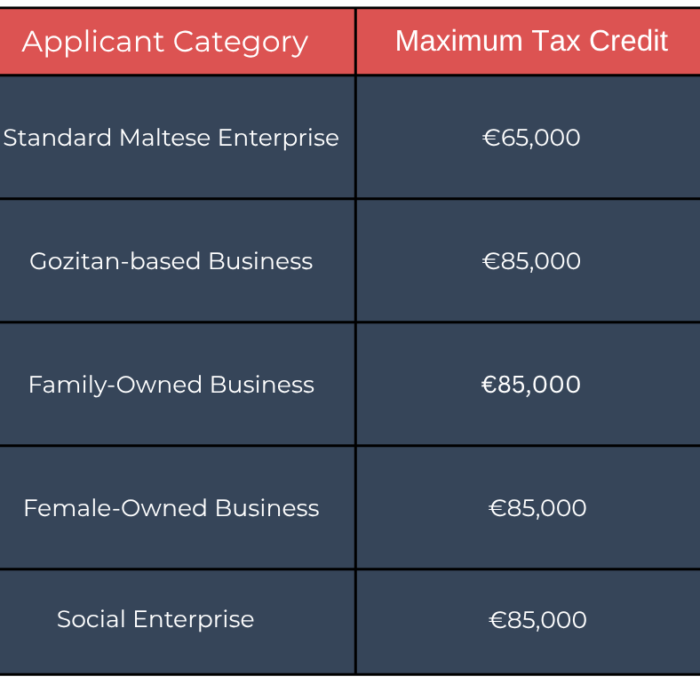
Female-Owned Business Definition
A business qualifies if the majority of ownership is female-based, OR if an individual woman holds a specific percentage (e.g., 20%) and all other shareholders hold less than that percentage each.
The 5-Year Absorption Rule: Approved tax credits can be absorbed within 5 years from the date included on the grant certificate.
Application Period and Cost Claims
Applications can now be submitted at any time throughout the year as fixed annual deadlines have been removed. Under the new rolling framework, businesses can claim qualifying costs from the prior 1, 2, or 3 years (e.g., an application filed in 2028 can cover 2026 and 2027 costs). However, once an application is submitted for a specific year, no further costs for that benchmark year can be added in future applications, so all expenses must be included in one go.
Add the CPA / Review timeline details:
- CPA Certified: Malta Enterprise will review the application within 4 weeks.
- Non-CPA Certified: Review can take up to 6 months.
- Note: Wage-related claims must always be certified by a CPA.
Wage Costs & Employee Retention
Eligibility for wage-related claims is strictly focused on employee retention and applies to full-time personnel under the following criteria:
- Full-Time Only: Tax credits apply exclusively to the increase in wage costs of full-time employees.
- New Threshold: The wage increase must be more than €5,000 compared to the lowest wage cost in the prior 2 years (replacing the old 3% threshold).
- Benchmark Caps: The wage cost in the prior 2 years cannot be lower than the wage cost incurred in the benchmark year 2025, nor can it be lower than that of the previously submitted application.
- CPA Requirement: All wage-related claims MUST be certified by a CPA.
Long-Term Employee “Top-Up” Incentive
An additional top-up incentive is available for businesses that increase the wages of long-term employees (employed for more than 4 years):
- The wage increase for the long-term employee must exceed 3%.
- Malta-based applicants: 65% tax credit of the increase, up to €780 per employee per year, for 2 consecutive years.
- Gozo-based applicants: 85% tax credit of the increase, up to 1,020 per employee per year, for 2 consecutive years.
- The second-year benefit is only applicable if the employee’s wage cost is maintained at the same level or increased.
Eligible Costs
- General Threshold: Only individual costs exceeding €500 (excluding VAT) are eligible for tax credits.
- Motor vehicles
- Other means of transport
- Vessels– must be covered by a commercial vessel licence issued by TM
- Aircraft– must be covered by a licence issued by TM
- Furniture & Fittings and Electronic Equipment
- Refurbishing of business premises
- Digital solutions
- Ineligible costs
- Transport fees
- Works of arts
- Antiques
- Spare parts
- Systems to produced alternative energy (such as solar panels)
- Software maintenance costs & renewal fees that do not meet Digital Solution criteria as per above
At Brainston Advisory Limited, we specialise in guiding businesses through the entire application lifecycle, from initial eligibility assessment to the final submission of the claim. Contact us today to get started.
Contact us
📞 +356 2152 1025/6
✉️ info@brainston.mt