

- Rental income is added to your personal income (e.g. salary, business income, pensions).
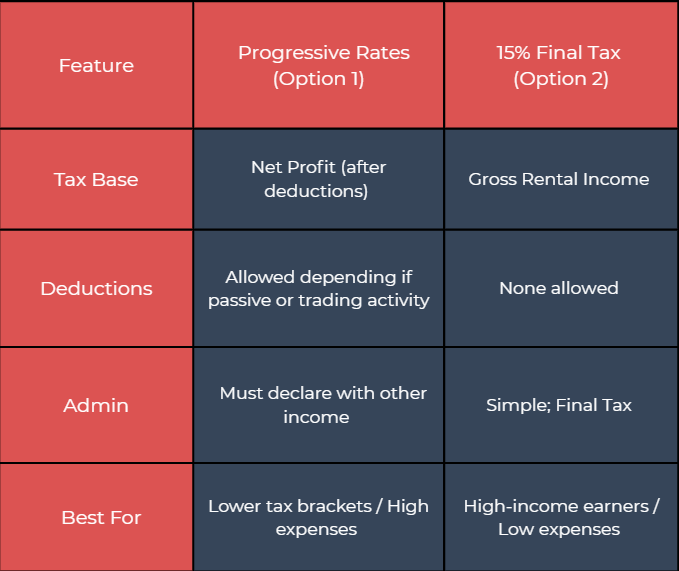
- Tax is calculated at the applicable progressive personal income tax rates.
- Tax is charged on the net profit (after allowable deductions).
However, allowable deductions depend on the nature of the rental activity (see section below).
This option may be beneficial where:
- The taxpayer falls within a lower tax bracket.
- Significant deductible expenses are incurred
- Passive income, or
- Trading income arising from a business activity
This classification directly affects deductibility and loss treatment.
In this case, tax is charged on the net rental profit, after deducting the following allowable expenses as per S.L. 123.26 Deduction of Expenses in respect of Immovable Property:
- Interest on loan used in relation to the immoveable property in question
- Rent, ground rent payable
- Licence payable
- 20% further deduction after deducting rent, ground rent and licence payable
Losses arising from passive activities may only be set off against passive profits and cannot be offset against active trading profits. Any unutilised passive losses may be carried forward to subsequent tax years for set-off against future passive profits.
Indicators may include:
- Letting multiple properties in an organised, commercial manner
- Short-term or holiday rentals involving services
- Frequent acquisition of property for rental purposes
In such cases:
- Expense incurred in the production of the income are deductable
- Capital allowances are allowable
- Trading losses may be carried forward and allowed against any source of income
- VAT and licensing obligations may arise
Short-let and tourism-related rentals may also require registration with the Malta Tourism Authority.
The classification is highly fact-dependent and must be assessed carefully.
- 15% tax on gross rental income
- No deductions allowed
- Tax is final (not added to your other income)
- Must be declared in the specific rental income form
- If you are in a higher income tax bracket (25%–35%)
- If your rental property has minimal expenses
- If you prefer administrative simplicity
⚠️ Important: Once selected for a particular property in a year of assessment, this method must be applied for any other rented property during that year. However, you can switch methods from one year to the next.
- Rental profits are taxed at 35% at company level.
- Deductions allowed depending whether the trading is of a passive or trading nature, as explained above.
- Upon distribution, shareholders may claim a tax refund under Refundable Tax Credit System
This option may be beneficial where:
- The company incurs substantial deductible expenses.
- Losses are to be carried forward.
- The activity amounts to trading.
Where this option is exercised:
- Tax is charged at 15% on gross rental income.
- No deductions are allowed.
- The tax is final.
- The income does not form part of the company’s chargeable income for corporate tax purposes.
- No tax refunds apply because the tax is final.
This can be attractive where:
- If the company has high rental margins and very few deductible expenses.
- The company does not require loss utilisation.
- Simplicity is preferred.
⚠️ Important: Once selected for a particular property in a year of assessment, this method must be applied for any other rented property during that year. However, you can switch methods from one year to the next.
- 10% tax on gross rental income
- No deductions allowed
- Tax is final
This regime is separate from the 15% option and is designed to support social housing initiatives.
- 5% tax on gross rental income
- No deductions allowed
- Tax is final
The restoration must meet statutory conditions and planning requirements, and the regime must be properly elected.
- Short-term/Tourist Lets: Subject to 7% VAT (and the increased €1.50 per night Eco-Contribution as of 2026).
- Commercial Lets: Often subject to 18% VAT if the tenant is a taxable person using the premises for economic activity.
- Evaluating the correct tax classification
- Comparing taxation options
- Ensuring full compliance with Maltese tax legislation
If you would like a personalised rental income tax review, our team would be pleased to assist.
Contact us
📞 +356 2152 1025/6
✉️ info@brainston.mt